About 58 minutes
The Colored People of Chicago An Investigation Made for the Juvenile Protective Association — A Reader’s Guide
Social Conditions
13,124 recorded words. 7 minutes difference from this book's estimate.
View Gutenberg source #60375
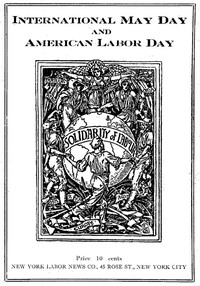
This digital edition of International May Day and American Labor Day A Holiday Expressing Working Class Emancipation Versus a Holiday Exalting Labor's Chains — Context and Discussion is described by source-level measurements including 11,632 words, 51 min estimated reading time, and 3 detected text sections.
The text analysis averages about 28.4 words per sentence, while the detected sections provide another way to judge how the source is divided.
Project Gutenberg metadata also associates the work with “Socialism,” connecting these edition facts with the source record’s subject description.
Explore this collection
These alternatives are selected using recorded categories and estimated reading time.
About 58 minutes
Social Conditions
13,124 recorded words. 7 minutes difference from this book's estimate.
View Gutenberg source #60375About 41 minutes
Social Conditions
9,427 recorded words. 10 minutes difference from this book's estimate.
View Gutenberg source #31301About 67 minutes
Social Conditions
15,309 recorded words. 16 minutes difference from this book's estimate.
View Gutenberg source #58570Search stored excerpts and compare books → Choose by your preferences →
Choices use stored catalog measurements. Estimates vary with reading speed. A shared category is a catalog label, not a claim that two books have the same argument or literary quality.
Search reads excerpt text stored with this catalog and links to its associated Gutenberg record. The connection is stored in the site database; this tool does not recheck that every excerpt is word-for-word identical to that external record. Excerpt search does not cover every chapter and does not verify historical publication dates.
Catalog snapshot checked: 2026-09-25. Coverage: 91 public books, 91 available source excerpts.
Read the complete public-domain text at its original source.
Read on Project GutenbergBoris Reinstein's pamphlet opens with a stark structural contrast: International May Day is presented as a holiday 'expressing working class emancipation,' while American Labor Day is framed as one 'exalting labor's chains.' This binary opposition shapes the entire work, which moves between historical exposition and pointed critique of labor leaders. Reinstein, writing from a Socialist Labor Party perspective, uses the two holidays as lenses to examine the broader class struggle. The text repeatedly shifts from abstract claims about capitalism to concrete cases, such as the political maneuvering around John Mitchell and James T. Lynch, grounding its argument in specific episodes.
Reinstein establishes his central dichotomy in the title and preface, where he describes May Day as a celebration of working-class emancipation and Labor Day as a holiday that exalts labor's chains. This framing recurs throughout the pamphlet, with each holiday representing opposing forces in the class struggle. The author does not merely describe the holidays but uses them as symbols: May Day embodies revolutionary potential, while Labor Day is depicted as a capitalist concession designed to pacify workers. The preface sets the stage by arguing that material conditions in America are ripe for socialism, yet the labor movement is undermined by leaders who serve capitalist interests. This structural opposition drives the pamphlet's argument, as Reinstein contrasts the international solidarity of May Day with the nationalist, conciliatory tone of Labor Day celebrations.
Reinstein devotes significant attention to John Mitchell, president of the United Mine Workers, using his political career as evidence of labor leaders' co-optation. The text recounts how Mitchell sought a state appointment from Governor Sulzer, only to be blocked by the Court of Appeals on procedural grounds. Reinstein's language is biting: he calls Mitchell a 'labor lieutenant'—a term he attributes to Senator Mark Hanna—and suggests that Mitchell's failure was due to 'too strictly partisan politics,' not opposition to him as a labor representative. The author implies that Mitchell will quickly find another 'fat political job,' reinforcing the claim that such leaders are beholden to capitalists. This episode serves as a concrete example of the pamphlet's broader argument that American labor leaders prioritize political patronage over working-class interests.
The pamphlet's second major case study focuses on James T. Lynch, International President of the Typographical Union. Reinstein presents a hypothetical internal monologue of Governor Sulzer weighing Lynch's suitability for appointment: 'First—Has Lynch enough of a following and influence in the Labor Movement to be able to “deliver the goods”?' The author answers by cataloging Lynch's credentials: a 'solid “a number one” Democrat,' a bitter enemy of socialism, and a member of the National Civic Federation and the 'Ultramontane Roman-Catholic “Militia of Christ.”' Reinstein then details Lynch's actions against a boycott in San Francisco and a lockout in Chicago, where he used threats to break worker solidarity. This section illustrates how the pamphlet moves from abstract critique to specific, documented betrayals, using Lynch as a symbol of labor leadership's alignment with capital.
Throughout the pamphlet, Reinstein alternates between theoretical assertions and empirical examples, creating a rhythm that reinforces his argument. The preface offers a broad historical materialist framework, describing how capitalist concentration has made socialism possible. Subsequent sections then test this framework against the actions of labor leaders. The text's movement is not linear but recursive: each new example—Mitchell, Lynch, and others—is introduced to illustrate the same thesis. This structure allows Reinstein to build a cumulative case, with each episode adding weight to his claim that American Labor Day is a tool of capitalist control. The pamphlet's brevity (under 12,000 words) means these shifts are rapid, and the reader is expected to follow the logical leaps from theory to evidence without extensive transitions.
Readers should approach this pamphlet as a polemical work that uses historical examples to support a Marxist interpretation of labor holidays. The text's value lies not in its completeness—it draws on selective episodes—but in its clear articulation of a specific political perspective. Pay attention to how Reinstein moves between abstract claims and concrete cases, and consider the rhetorical force of his binary framing. The pamphlet is best understood as a primary document of early 20th-century socialist thought, offering insight into the factional debates within the labor movement.
Reading about how May Day once carried such a fierce, hopeful weight makes me think of old union songs my grandfather hummed. There’s something in that struggle that lingers, like a half-remembered face. It’s the same ache I felt turning the pages of Stand Up, Ye Dead — A Reader’s Guide, where forgotten voices seem to whisper just beneath the print. A quiet kind of reckoning.
Create a short personal record of your experience with this book.









