
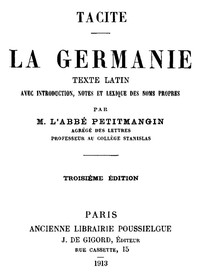
La Germanie by Cornelius Tacitus
Written around 98 AD, 'Germania' isn't a story in the traditional sense. It's a report, an ethnography of the various tribes living in the vast, forested lands beyond the Roman Empire's northern frontier. Tacitus systematically describes their land, their social structures, their religion, and their daily life. He talks about their bravery in battle, their strict moral codes, their practice of settling disputes through single combat, and the surprising authority held by their women. He paints a picture of a people defined by simplicity, ferocity, and a deep love of freedom.
Why You Should Read It
Here's the secret: Tacitus is doing way more than just listing facts. As a Roman senator, he lived through the tyrannical rule of Emperor Domitian. 'Germania' is his brilliant, sideways critique of everything he saw rotting in Rome. When he praises the Germans for electing their leaders based on merit and fighting for glory rather than gold, he's highlighting Roman political corruption and greed. When he notes their women are respected prophets and that adultery is virtually unknown, he's commenting on the scandal and decadence of Roman high society. The book crackles with this unspoken irony. You're constantly asking, 'Is he really admiring these so-called barbarians? Is he saying they're better than us?' It's a masterclass in saying something dangerous without directly saying it.
Final Verdict
This isn't a dry history text. It's a sharp, provocative essay that feels incredibly fresh. It's perfect for anyone who loves history that speaks to the present, for readers who enjoy political satire (even from 2,000 years ago!), and for those curious about how one culture defines another to define itself. It's also very short and accessible. If you've ever wondered how the Romans saw the rest of the world, or if you just enjoy a clever piece of writing that packs a punch, give 'Germania' an afternoon of your time. You might just see a bit of both Rome and Germania in the world around you today.
This work has been identified as being free of known copyright restrictions. You do not need permission to reproduce this work.
Joshua Perez
1 year agoAfter finishing this book, it creates a vivid world that you simply do not want to leave. Worth every second.
Joshua Scott
1 year agoGreat digital experience compared to other versions.
Liam Torres
2 years agoFrom the very first page, it provides a comprehensive overview perfect for everyone. A valuable addition to my collection.
Mason Lewis
8 months agoThanks for the recommendation.

Emily Hernandez
1 year agoUsed this for my thesis, incredibly useful.