
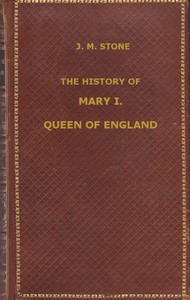
The History of Mary I, Queen of England by J. M. Stone
Forget the cartoon villain. J.M. Stone’s The History of Mary I, Queen of England introduces us to Mary Tudor as a full, complicated person. Published in 1901, it was one of the first major works to seriously re-examine her life beyond the fiery legend.
The Story
The book follows Mary from her beginnings as the cherished, Catholic daughter of Henry VIII and Catherine of Aragon. Her world shatters when her father divorces her mother, declares her illegitimate, and replaces the Catholic church with his own. We see Mary stripped of her title, separated from her mother, and forced to deny her faith to survive. Her eventual rise to the throne in 1553 is less a triumph and more a desperate last stand for everything she believed was stolen from her family and her country. Stone walks us through her short, five-year reign: her marriage to Philip of Spain, the false pregnancies that crushed her spirit, and the religious policies that cemented her grim reputation. The narrative doesn’t shy away from the burnings, but it firmly places them in the context of a 16th-century monarch doing what she, and most of Europe, believed was right: eradicating heresy to save souls and secure the kingdom.
Why You Should Read It
What makes this book so compelling is its sense of empathy without apology. Stone doesn’t whitewash Mary’s actions, but she builds a powerful case for how they were forged. You feel the weight of Mary’s loneliness, the deep trauma of her youth, and her unwavering conviction. You see a highly educated, politically savvy woman trapped by the brutal expectations of her time and her own rigid conscience. Reading it, you stop seeing a one-dimensional tyrant and start seeing a tragic figure—a woman trying to fix her broken world with the only tools she understood, tools that now horrify us. It’s a masterclass in historical perspective.
Final Verdict
This is perfect for anyone who loves a deep character study or feels that history is more about people than dates. If you enjoyed Wolf Hall but wanted the focus on the other side of Henry’s divorce, start here. Be warned: it’s an older biography, so the writing style is formal in places, and some historical interpretations have evolved. But as a passionate, detailed, and profoundly human portrait of a queen we only think we know, it remains utterly fascinating. You might not like Mary by the end, but you will understand her, and that’s far more interesting.
This digital edition is based on a public domain text. You do not need permission to reproduce this work.




Edward Anderson
1 year agoGreat digital experience compared to other versions.