About 363 minutes
Labour and the Popular Welfare — Themes and Context
Social Conditions
83,280 recorded words. 1 minutes difference from this book's estimate.
View Gutenberg source #66518
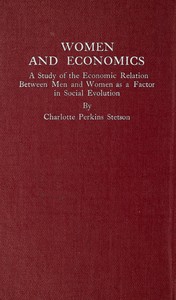
Before opening Women and Economics A Study of the Economic Relation Between Men and Women as a Factor in Social Evolution — Edition Insights, the edition data offers a quick orientation: 83,195 words, 6 hr 2 min estimated reading time, and 20 detected text sections.
The text analysis averages about 19.1 words per sentence, while the detected sections provide another way to judge how the source is divided.
Project Gutenberg metadata also associates the work with “Women -- Social and moral questions,” connecting these edition facts with the source record’s subject description.
Explore this collection
These alternatives are selected using recorded categories and estimated reading time.
About 363 minutes
Social Conditions
83,280 recorded words. 1 minutes difference from this book's estimate.
View Gutenberg source #66518About 360 minutes
Social Conditions
82,709 recorded words. 2 minutes difference from this book's estimate.
View Gutenberg source #49990About 352 minutes
Social Conditions
80,790 recorded words. 10 minutes difference from this book's estimate.
View Gutenberg source #71194Search stored excerpts and compare books → Choose by your preferences →
Choices use stored catalog measurements. Estimates vary with reading speed. A shared category is a catalog label, not a claim that two books have the same argument or literary quality.
Search reads excerpt text stored with this catalog and links to its associated Gutenberg record. The connection is stored in the site database; this tool does not recheck that every excerpt is word-for-word identical to that external record. Excerpt search does not cover every chapter and does not verify historical publication dates.
Catalog snapshot checked: 2026-09-25. Coverage: 91 public books, 91 available source excerpts.
Read the complete public-domain text at its original source.
Read on Project GutenbergCharlotte Perkins Gilman opens Women and Economics with a poem, not a thesis. The proem casts prehistoric humans as "comrades dear and daring" and traces a fall into gendered bondage: man bound woman "close, close" and kept her "weak still." This poetic frame sets the book's rhetorical strategy—Gilman will argue from evolutionary biology and economic history, but she begins with a myth of lost equality. The prose that follows is dense with analogies drawn from natural science: she compares human social arrangements to those of ants, bees, and mammals, and she insists that what we call "instinct" in women is often a stunted substitute for developed intelligence. Readers should note how Gilman moves between the language of the laboratory and the language of moral indictment, a combination that gives the book its distinctive argumentative force.
Gilman's central claim is that women are the only class of beings in which the sex-function is allowed to overshadow the race-function. She writes that "the human female, denied the enlarged activities which have developed intelligence in man, has maintained the rudimentary forces of instinct to the present day." This is not a complaint about unequal pay; it is an argument about biological and social evolution. She contends that the economic relation between men and women—where women exchange domestic service for subsistence—has artificially exaggerated sexual characteristics and retarded human progress. The evidence she marshals includes comparisons to other species, where females are not economically dependent, and historical examples of women's work in earlier societies. Her diction is clinical: she speaks of "race-preservative processes" and "self-preservative processes" as if dissecting a specimen. Yet the tone is also urgent, even angry, as when she describes maternal instinct as "unworthy of our superstitious reverence."
In one of the book's most concrete passages, Gilman turns to the feeding of infants. She notes that maternal instinct does not teach a woman "such habits of life as insure her ability to fulfil this natural function." When instinct fails, the mother must choose among competing brands—"Marrow's Food and Bridge's Food, Hayrick's Food and Pestle's Food, Pennywhistle's Sterilized Milk"—all prepared by men. The list is deliberately absurd, a rhetorical device that underscores her point: instinct is useless in a commercial society. Gilman argues that motherhood has been left to "absolutely untaught women," and that the reverence for "divine instinct" masks a failure to educate women for their most important work. This section exemplifies her method: she takes a mundane domestic task and uses it to expose a structural contradiction. The humor in the brand names is rare; most of the book maintains a stern, analytical register.
Gilman's prose is saturated with the language of nineteenth-century evolutionary theory. She speaks of "modification to sex," "race-preservative processes," and "the will of man" as a force that can "seize" pleasure. This vocabulary does more than lend scientific authority; it structures her argument. She treats society as an organism that has developed a pathological specialization—the economic dependence of women—and she prescribes a return to a more balanced differentiation of functions. Her sentences are often long and hypotactic, piling up clauses that mimic the accumulation of evidence. But she also uses short, declarative statements for emphasis: "Maternal love is an enormous force, but force needs direction." The book's rhetorical power lies in this alternation between the taxonomic and the aphoristic. Readers should attend to how Gilman uses the word "instinct" as a term of art, stripping it of sentimental associations and redefining it as a primitive, often inadequate, guide to action.
Gilman's reliance on biological analogy is both the strength and the vulnerability of her argument. She assumes that human social arrangements can be evaluated by the same criteria as those of other species, and that evolution has a direction—toward greater complexity and intelligence. This allows her to condemn current practices as "arrested development." But it also commits her to a teleological view of history that may strike modern readers as dated. She does not, for instance, consider the possibility that the economic relation between men and women might be a product of contingent historical forces rather than a deviation from a natural norm. The excerpts do not reveal whether she addresses counterexamples—societies where women have economic power—or whether she engages with alternative economic theories. What is clear is that her argument is built on a foundation of natural law, and that she expects her readers to share her faith in evolutionary progress.
Gilman's book is best read as a work of polemical social science, not as a dispassionate study. The evidence she uses is selective, the analogies are sometimes strained, and the evolutionary framework has not aged well. But the core insight—that the economic dependence of women has profound psychological and social consequences—remains provocative. Readers who approach Women and Economics as a historical document will find a vivid example of how early feminist thinkers used the intellectual tools of their time to challenge the status quo.
That gray afternoon, Women and Economics sat open on my lap, her argument about stunted growth settling like rain on the windowsill. I kept thinking of children, of how we shape them before they choose. Later, reaching for a dry cloth, my hand found The American Child — Story, Setting & Ideas instead. It felt less like a next step, more like a window left ajar.
Use these questions to collect your thoughts before moving on.









