
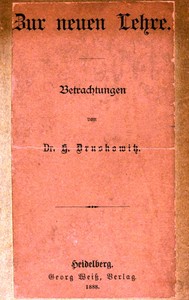
Zur neuen Lehre: Betrachtungen by H. Druskowitz
Let's be clear from the start: this isn't a novel. Zur neuen Lehre: Betrachtungen (which translates to On the New Teaching: Observations) is a series of philosophical essays published in 1885. There's no plot in the traditional sense. Instead, Helene Druskowitz, one of the first women in Austria to earn a doctorate, lays out her arguments against the dominant ideologies of her time.
The Story
Think of it less as a story and more as a guided tour through Druskowitz's mind. She structures her 'observations' as a critique. She takes aim at organized religion, particularly Christianity, questioning its moral authority and its impact on human freedom. She argues against blind nationalism and the uncritical worship of the state. A central thread is her frustration with what she sees as humanity's tendency toward 'herd mentality' and our fear of independent, rational thought. The 'new teaching' she proposes isn't a neat, packaged solution, but a call to arms for skepticism, intellectual courage, and a philosophy built on reason rather than tradition or dogma.
Why You Should Read It
I picked this up out of historical curiosity, but I was struck by how fierce and modern Druskowitz sounds. Her writing isn't dry or academic; it's passionate and often bitingly sarcastic. Reading her dismantle the arguments of her era, you can feel her impatience with nonsense. What's most compelling is hearing this voice from a woman in the 1880s, a time when her very presence in this intellectual arena was radical. It reframes the whole period. You realize the debates about faith, reason, and society we think are modern have very deep roots. It’s a powerful reminder that brilliant, critical minds have always existed on the margins.
Final Verdict
This book is perfect for readers who love history, philosophy, or feminist thought and don't mind a challenging, non-narrative text. It's for anyone who enjoys primary sources that crackle with personality. If you've ever wondered what a truly independent thinker in the Victorian era sounded like—especially one society tried hard to ignore—Druskowitz is a revelation. It's a short but dense read, best taken in small sections. Not for someone looking for a light story, but absolutely for the reader who wants a bold, unfiltered voice from the past to shake up their present thinking.
This work has been identified as being free of known copyright restrictions. Enjoy reading and sharing without restrictions.
Susan Lee
1 year agoI appreciate the objective tone and the evidence-based approach.
Ethan Lee
1 year agoEssential reading for students of this field.
Ethan Robinson
1 year agoUsed this for my thesis, incredibly useful.
Donald Young
2 years agoHonestly, the plot twists are genuinely surprising. A true masterpiece.
James Moore
8 months agoBefore I started my latest project, I read this and the critical analysis of current industry standards is very timely. Truly a masterpiece of digital educational material.