About 138 minutes
The Peoples of India — Background and Themes
Anthropology
31,700 recorded words. 55 minutes difference from this book's estimate.
View Gutenberg source #55465
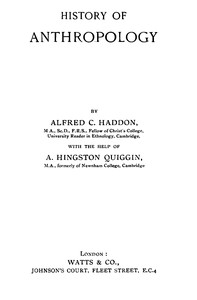
For History of anthropology — Edition Insights, the stored edition analysis reports 44,190 words, 3 hr 13 min estimated reading time, and 20 detected text sections.
The text analysis averages about 20.1 words per sentence, while the detected sections provide another way to judge how the source is divided.
Project Gutenberg metadata also associates the work with “Anthropology -- History,” connecting these edition facts with the source record’s subject description.
Explore this collection
These alternatives are selected using recorded categories and estimated reading time.
About 138 minutes
Anthropology
31,700 recorded words. 55 minutes difference from this book's estimate.
View Gutenberg source #55465About 46 minutes
Anthropology
10,384 recorded words. 147 minutes difference from this book's estimate.
View Gutenberg source #74049About 43 minutes
Anthropology
9,738 recorded words. 150 minutes difference from this book's estimate.
View Gutenberg source #18869Search stored excerpts and compare books → Choose by your preferences →
Choices use stored catalog measurements. Estimates vary with reading speed. A shared category is a catalog label, not a claim that two books have the same argument or literary quality.
Search reads excerpt text stored with this catalog and links to its associated Gutenberg record. The connection is stored in the site database; this tool does not recheck that every excerpt is word-for-word identical to that external record. Excerpt search does not cover every chapter and does not verify historical publication dates.
Catalog snapshot checked: 2026-09-25. Coverage: 91 public books, 91 available source excerpts.
Read the complete public-domain text at its original source.
Read on Project GutenbergFrom its opening sentence, History of Anthropology adopts a tone of scholarly diffidence. The authors describe their work as “the first attempt at a history of Anthropology” and immediately anticipate criticism from specialists. This defensive posture shapes the entire narrative: the book is less a triumphal chronicle than a careful negotiation between competing national traditions and emerging subdisciplines. The preface’s apology for a “British” bias and the admission that many living workers could not be mentioned signal a self-consciousness about the provisional nature of the project. Throughout, the prose moves between brisk summaries of individual careers and broader reflections on methodological shifts, creating a rhythm that mirrors the discipline’s own uneven development.
The dual authorship—Haddon, a Cambridge reader in ethnology, and Quiggin, a former Newnham fellow—produces a text that frequently shifts between first-person plural and impersonal exposition. The preface uses “we” to acknowledge debts and limitations, but the body chapters rarely foreground the authors’ own judgments. Instead, they rely on a cataloging style: Blumenbach “the founder of Craniology,” Bastian’s life “filled with his work.” This approach keeps the focus on the figures being described, yet it also reveals the authors’ reliance on a network of living informants. The acknowledgments to Dr. C. S. Myers and others underscore how the book itself is embedded in the scholarly community it attempts to historicize. The result is a narrative that feels both authoritative and provisional, as if the authors are aware that their account will soon be superseded.
The text repeatedly contrasts British and German approaches to anthropology. British physical anthropology, as presented, emphasizes craniometry and anthropometry—measurable, empirical data. German scholarship, by contrast, is associated with philosophical breadth: Bastian’s Völker-Gedanken and Wundt’s Völkerpsychologie are described as “master-builder” projects. The authors note that “the ideas of folk psychology were in the air” in Germany, implying a more speculative tradition. Yet they also highlight the Cambridge expedition to Torres Straits (1898) as a decisive methodological advance, where “trained experimental” psychologists studied non-European subjects under controlled conditions. This juxtaposition suggests a quiet rivalry: British empiricism versus German system-building. The authors do not explicitly declare a winner, but their detailed treatment of the Torres Straits expedition—and its contrast with earlier, “unsatisfactory” studies of show performers—hints at a preference for field-based, collaborative science.
The book’s structure accelerates as it moves from physical anthropology to psychology. Early chapters on craniology and anthropometry proceed methodically, listing names and indices. But when the narrative reaches the late nineteenth century, the pace quickens. The section on experimental psychology compresses Fechner, Galton, and Wundt into a few paragraphs, and the Torres Straits expedition is introduced as a “new departure.” This shift reflects the authors’ sense that psychology was the discipline’s most dynamic frontier. They note that experimental psychology had been “mainly concerned with subjects numbered 2, 3, and 5” in an earlier table—a cryptic reference that underscores the field’s narrow base before 1898. The brevity of these later sections, combined with the authors’ evident excitement about the Torres Straits work, gives the closing chapters a forward-looking energy that contrasts with the measured tone of the opening.
Readers approaching this 1910 history should attend to its silences as much as its statements. The authors’ diffidence about their own selections—why some figures are omitted, why space is allocated unevenly—invites a critical reading. Pay attention to the footnotes and the bibliography, which reveal the authors’ debts and gaps. The book is best understood not as a definitive record but as a snapshot of a discipline in transition, caught between the desire for comprehensive coverage and the awareness that the story is still unfolding.
There’s something tender about how Haddon and Quiggin hedged their words, tiptoeing between German and British schools, as if afraid of bruising a colleague’s pride. I kept thinking of that same careful hesitancy reading about early American anthropology’s institutional growing pains. It’s less about conclusions and more about the quiet anxiety of building a discipline—how we all carry our mentors’ worries. Anthropology As a Science and as a Branch of University Education in the United States — Themes and Context felt like the same uneasy letter, written to a different friend.
A brief reflection can help important ideas stay with you longer.