About 129 minutes
The Rural Life Problem of the United States Notes of an Irish Observer — Text and Context
Social Conditions
29,538 recorded words. 2 minutes difference from this book's estimate.
View Gutenberg source #27305
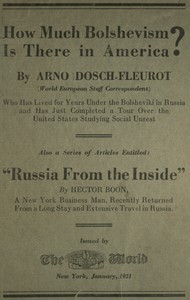
Before opening How much Bolshevism is there in America? — Context and Discussion, the edition data offers a quick orientation: 29,984 words, 2 hr 11 min estimated reading time, and 5 detected text sections.
The text analysis averages about 20.1 words per sentence, while the detected sections provide another way to judge how the source is divided.
Project Gutenberg metadata also associates the work with “Communism -- Soviet Union,” connecting these edition facts with the source record’s subject description.
Explore this collection
These alternatives are selected using recorded categories and estimated reading time.
About 129 minutes
Social Conditions
29,538 recorded words. 2 minutes difference from this book's estimate.
View Gutenberg source #27305About 125 minutes
Social Conditions
28,722 recorded words. 6 minutes difference from this book's estimate.
View Gutenberg source #67371About 138 minutes
Social Conditions
31,639 recorded words. 7 minutes difference from this book's estimate.
View Gutenberg source #14760Search stored excerpts and compare books → Choose by your preferences →
Choices use stored catalog measurements. Estimates vary with reading speed. A shared category is a catalog label, not a claim that two books have the same argument or literary quality.
Search reads excerpt text stored with this catalog and links to its associated Gutenberg record. The connection is stored in the site database; this tool does not recheck that every excerpt is word-for-word identical to that external record. Excerpt search does not cover every chapter and does not verify historical publication dates.
Catalog snapshot checked: 2026-09-25. Coverage: 91 public books, 91 available source excerpts.
Read the complete public-domain text at its original source.
Read on Project GutenbergThe volume pairs two distinct journalistic investigations: Arno Dosch-Fleurot’s five articles on American social unrest, written after he lived through the Bolshevik revolution in Petrograd, and Hector Boon’s six-part series “Russia from the Inside,” based on his extensive travel in Siberia. The editor’s note frames Dosch-Fleurot’s work as a search for “how much Bolshevism he could find” in the United States, while Boon’s account moves through checkpoints, propaganda trains, and encounters with commissars. The structure—two separate series under one cover—creates a deliberate contrast between domestic and foreign perspectives, each grounded in firsthand observation rather than abstract theory.
The book is not a single narrative but a compilation of two newspaper series, each with its own author, itinerary, and focus. Dosch-Fleurot, identified as the only American correspondent in Petrograd during the 1917 revolution, traveled across the United States to gauge the impact of European upheaval. Boon, a New York businessman recently returned from Russia, describes his passage through Siberian towns under Red control. The editor’s note explicitly separates their contributions, and the text itself maintains this division: Dosch-Fleurot’s articles are numbered and titled, while Boon’s are introduced with a separate heading. This dual structure allows the reader to compare how each journalist frames similar questions—about labor, governance, and revolutionary sentiment—from opposing geographic vantage points.
Boon’s narrative is built around physical movement: he arrives at a Japanese outpost, presents papers, is delayed, then proceeds to a Red position. The journey is punctuated by encounters with officials and material details—wagons attached to a post train, a propaganda train in the station, a commissar’s modest room with “a deal table, a few chairs and a truckle bed.” These details ground the political analysis in concrete settings. The recurring image of the train, both as transport and as a vehicle for Bolshevik propaganda (the train “in charge of Dvornik”), underscores the theme of movement as a means of control and observation. Dosch-Fleurot’s American tour, by contrast, is described in the editor’s note as a journey “about the country,” but the excerpts do not reveal its specific itinerary; the contrast between the two reporters’ modes of travel—one through war-torn Siberia, the other across a prosperous United States—is implicit in the book’s structure.
Boon’s encounter with Commissar Krassnochokoff, who claims the Far Eastern Republic is a separate, moderate state, is immediately undercut by visual evidence: “the entire population was sporting hastily improvised red stars and rosettes.” Boon notes his skepticism, and later confirms that “the buffer state exists only in name. It is part of Soviet Russia, administered by Moscow on the communist system.” This observation—that political labels can mask reality—echoes the book’s central question about how much Bolshevism actually exists in America. The detail of Krassnochokoff’s later conflict with Moscow, and the threat from “the butcher Dzherjinsky,” adds a layer of personal risk to the political analysis. Boon’s desire to see “uncamouflaged Bolsheviks” and to test whether “the wild beasts I had known in 1917 and 1918 had become tame” reveals his own evolving perspective, shaped by the atrocities committed by both sides.
Dosch-Fleurot’s series is introduced as a contrast between America’s “war-born wealth” and the “war-impoverished countries of Europe.” The editor’s note frames this as an insurance against Bolshevism, but the excerpts do not develop the argument further. Boon’s account, however, repeatedly emphasizes scarcity: the population is “half starved,” industry has died, and firing squads execute those who criticize commissar rule. The juxtaposition of American abundance with Siberian deprivation is structural, not explicit—the book places Dosch-Fleurot’s domestic survey alongside Boon’s foreign report, inviting the reader to weigh the conditions that foster or prevent revolutionary sentiment. The recurring image of improvised red stars, hastily made, suggests a performative aspect to Bolshevik allegiance, while the commissar’s assurance that “there would be no confiscation or requisitioning” is contradicted by the surrounding evidence of economic collapse.
Readers should approach this volume as two separate reports bound together for comparison, not as a unified argument. The excerpts provide only fragments of each series; the full text likely contains more detailed analysis of American labor movements and Russian daily life. Pay attention to the dates—January 1921—and the context of the Red Scare in the United States. The book’s value lies in its contemporaneous, on-the-ground perspective, filtered through the biases and limitations of its authors.
I think often of that 1921 series, two reporters circling the same restless century from opposite shores. Reading it, I was reminded of another voice, one that saw the gilded age as a veil over deeper troubles. There is a quiet kinship between such books, a shared knowing that power’s shine rarely tells the whole story, as The Reign of Gilt — Key Ideas to Explore gently confirms.
Create a short personal record of your experience with this book.









