About 167 minutes
The Queen's Daughters in India — Story, Setting & Ideas
Social Conditions
38,381 recorded words. 1 minutes difference from this book's estimate.
View Gutenberg source #47288
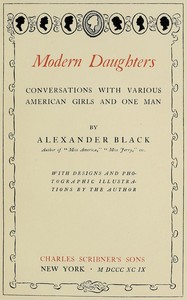
The catalog record for Modern daughters — Edition Insights provides practical reading context through 38,009 words, 2 hr 46 min estimated reading time, and 13 detected text sections.
The text analysis averages about 14.2 words per sentence, while the detected sections provide another way to judge how the source is divided.
Project Gutenberg metadata also associates the work with “Women -- Social and moral questions,” connecting these edition facts with the source record’s subject description.
Explore this collection
These alternatives are selected using recorded categories and estimated reading time.
About 167 minutes
Social Conditions
38,381 recorded words. 1 minutes difference from this book's estimate.
View Gutenberg source #47288About 163 minutes
Social Conditions
37,402 recorded words. 3 minutes difference from this book's estimate.
View Gutenberg source #33636About 172 minutes
Social Conditions
39,387 recorded words. 6 minutes difference from this book's estimate.
View Gutenberg source #27448Search stored excerpts and compare books → Choose by your preferences →
Choices use stored catalog measurements. Estimates vary with reading speed. A shared category is a catalog label, not a claim that two books have the same argument or literary quality.
Search reads excerpt text stored with this catalog and links to its associated Gutenberg record. The connection is stored in the site database; this tool does not recheck that every excerpt is word-for-word identical to that external record. Excerpt search does not cover every chapter and does not verify historical publication dates.
Catalog snapshot checked: 2026-09-25. Coverage: 91 public books, 91 available source excerpts.
Read the complete public-domain text at its original source.
Read on Project GutenbergAlexander Black’s Modern Daughters (1899) is built as a sequence of ten conversations, each with a woman who represents a recognized social category: the Débutante, the Left-Over Girl, the Gym Girl, the Heroine, the Clubwoman, the Cynic, the Chaperon, the Engaged Girl, the Bride—and, notably, one man, the “Nice Man.” The book’s structure is itself a statement: by giving each type its own chapter, Black implies that these roles are both real and performative, shaped by the expectations of society. The conversations are framed by a first-person narrator who is both observer and participant, and the photographic illustrations—taken by the author—add a documentary layer, insisting that these are actual young women, not mere inventions.
The book’s ten chapters are all dialogues, but they are not symmetrical debates. The narrator’s voice is consistent, but his interlocutors speak in distinct registers. In “With a Débutante,” the girl’s speech is marked by social caution and a kind of practiced lightness; in “With a Cynic,” the language sharpens into epigrammatic critique. This variation in tone and pace gives each conversation its own texture. Black does not use chapter summaries or thematic interludes; the reader learns each woman’s character entirely through what she says and how she responds to the narrator’s prompts. The structure thus mirrors the social situation it describes: identity is revealed in conversation, not in monologue.
Black was a photographer, and the book’s illustrations are his own camera studies. But the camera also appears as a metaphor within the text. In the preface, Black writes that his camera has saved his pen “the impossible task of describing the beauty of the American girl.” This is not just a boast; it signals a recurring concern with how women are seen and how they present themselves. The narrator frequently comments on appearance—a girl’s dress, her manner, her “pictorial effect”—and the women themselves are aware of being watched. The Clubwoman, for instance, describes how a charity board rejects a needy old man because his red hair does not fit “the scheme of the pictorial effect.” The image of the camera, then, is not neutral; it implies a social world where visual presentation is a form of currency.
The conversations are not static; they often take place while walking, riding in a hansom cab, or pausing at a shop. In the excerpt from “With a Débutante,” the narrator waits in a hansom while Mrs. Fentley runs into Ammerlin’s for curtains. This movement—from street to shop to cab—creates a sense of urban rhythm. The city is not just a backdrop; it is a stage where social types encounter one another. The narrator meets Dick Fentley on the street, and the conversation shifts from charity work to the problem of handsome men. These transitions are swift and natural, mimicking the way real social life unfolds in fragments. The book’s structure, then, is not merely a series of set pieces; it is a sequence of encounters that feel contingent, as if the narrator might have met a different girl on a different day.
Chapter VIII, “With a Nice Man,” is the only conversation with a male subject. Its placement—between the Chaperon and the Engaged Girl—is suggestive. The “Nice Man” is not a type in the same sense as the others; he is defined by a lack of distinctive features, a kind of social blank. By including him, Black implicitly asks whether men, too, are typed by society, or whether the category “man” is simply the unmarked norm against which women are measured. The chapter’s title is ironic: “nice” is a word often applied to women, and its use here may hint that the man’s niceness is itself a performance. The book’s structure, with ten chapters for women and one for a man, underscores the asymmetry of social typing.
Readers approaching Modern Daughters should attend to the interplay between the photographs and the text: the images are not illustrations of the conversations but independent portraits, and the relationship between what is said and what is shown is often oblique. Black’s preface warns that the “pictorial obligato” may seem indifferent to the “tune of the text,” and that is part of the book’s design. The conversations themselves reward careful attention to who speaks, who listens, and what is left unsaid.
Reading these portraits of late‑century daughters, I remembered my own grandmother’s stubborn silence at family dinners—type and selfhood pulling against each other. That same tension surfaced later in A New Conscience and an Ancient Evil — Text and Context, where societal expectation presses harder on quieter lives. Both books felt less like arguments, more like rooms where someone finally let you sit down.
Create a short personal record of your experience with this book.









