About 166 minutes
Modern daughters — Edition Insights
Social Conditions
38,009 recorded words. 1 minutes difference from this book's estimate.
View Gutenberg source #71170
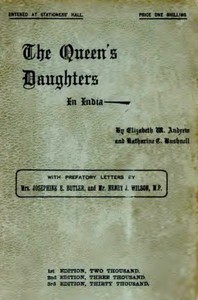
This digital edition of The Queen's Daughters in India — Story, Setting & Ideas is described by source-level measurements including 38,381 words, 2 hr 47 min estimated reading time, and 13 detected text sections.
The text analysis averages about 26.3 words per sentence, while the detected sections provide another way to judge how the source is divided.
Project Gutenberg metadata also associates the work with “Women -- India -- Social conditions,” connecting these edition facts with the source record’s subject description.
Explore this collection
These alternatives are selected using recorded categories and estimated reading time.
About 166 minutes
Social Conditions
38,009 recorded words. 1 minutes difference from this book's estimate.
View Gutenberg source #71170About 163 minutes
Social Conditions
37,402 recorded words. 4 minutes difference from this book's estimate.
View Gutenberg source #33636About 172 minutes
Social Conditions
39,387 recorded words. 5 minutes difference from this book's estimate.
View Gutenberg source #27448Search stored excerpts and compare books → Choose by your preferences →
Choices use stored catalog measurements. Estimates vary with reading speed. A shared category is a catalog label, not a claim that two books have the same argument or literary quality.
Search reads excerpt text stored with this catalog and links to its associated Gutenberg record. The connection is stored in the site database; this tool does not recheck that every excerpt is word-for-word identical to that external record. Excerpt search does not cover every chapter and does not verify historical publication dates.
Catalog snapshot checked: 2026-09-25. Coverage: 91 public books, 91 available source excerpts.
Read the complete public-domain text at its original source.
Read on Project GutenbergThe Queen's Daughters in India opens with a preface that immediately establishes its rhetorical stance: the authors write under a 'deep sense of obligation to the womanhood of the world' and a 'sense of duty to God.' This dual appeal—to secular moral responsibility and religious conviction—sets the tone for a text that moves between personal testimony, official correspondence, and polemical argument. The narrative voice is collective and urgent, often shifting from measured exposition to indignant commentary, as when the authors contrast the British aristocracy's advocacy of licensed vice with the plight of Indian women. The pace varies markedly: detailed journal entries, such as the February 1892 account of a Lock Hospital examination day in Meerut, slow the narrative to a near-ethnographic observation, while passages quoting official despatches accelerate into sharp critique.
The text juxtaposes two distinct modes of writing. One is the bureaucratic language of military and colonial administration: phrases such as 'female medical assistants be employed to conduct the examinations' and 'disease has been reduced to a minimum among the soldiers' appear in official despatches and certificates. The other is the visceral, scene-based reporting of the authors' own observations. In the Meerut journal entry, the prose becomes concrete and sensory: 'the girls, in gaudy apparel and flashy jewelry, were assembling,' 'a tall native policeman stood about,' 'tiny children looked on with interest and curiosity.' This shift from abstract policy to embodied detail forces the reader to confront the human reality behind the official language. The authors do not merely quote documents; they reframe them, pointing out that the certificates praised the superintendent's work only for its effect on soldiers' health, never on the women's. The alternation between these registers creates a rhythm of accusation: the coldness of officialese is repeatedly undercut by the warmth—and horror—of direct witness.
The authors employ a consistent first-person plural—'we believe,' 'we wonder,' 'we take a chapter out of the history of our India work'—that positions them as a unified, authoritative pair. This 'we' is not merely editorial; it claims shared experience and moral consensus. At the same time, the text frequently uses direct address, as in 'the women of England are being besought to turn their eyes on the future wives of British officers and soldiers; it would be for England’s lasting good would they but persistently keep their eyes on the British officers’ and soldiers’ present wives and children.' Here the 'you' is implicit but unmistakable: the reader, especially the British woman, is called to action. This rhetorical strategy creates a sense of immediacy and personal responsibility. The voice is that of a prophet or reformer, not a detached analyst. The pace quickens in these hortatory passages, with longer, complex sentences that build toward a moral imperative, contrasting with the more measured, descriptive sections.
The book's argument is built through a deliberate arrangement of different textual forms. The journal entry from Meerut is the most extended piece of first-hand narrative in the excerpts, and it functions as a kind of set-piece: a slow, detailed description of a Lock Hospital examination day, complete with the number of girls, the vehicles they arrived in, the presence of a native policeman, and the crowd of men and boys. This is followed by a certificate praising a mahaldarni (female superintendent) for keeping soldiers healthy, and then by the authors' commentary that the certificate never mentions the women's own health. The sequence is carefully orchestrated: the journal provides the scene, the certificate provides the official language, and the commentary provides the moral interpretation. The pace slows for the journal, quickens for the certificate, and becomes pointed in the commentary. This tripartite structure recurs throughout the excerpts, suggesting a methodical approach to persuasion: first show, then quote, then judge.
Readers attentive to shifts in tempo will find that the book's most powerful moments come when the authors let a scene unfold in its own time—the waiting girls, the passing carts, the lounging men—before stepping in to interpret. The alternation between narrative and argument is not accidental; it is a deliberate rhetorical design meant to move the reader from observation to conviction. Pay attention to how the authors handle transitions between these modes, and to the moments when the pace slows to a near-stop, as in the Meerut entry, for those are the hinges on which the book's moral weight turns.
That rainy afternoon, The Queen’s Daughters in India left me sitting very still, struck by how the reformers’ careful citations of official documents couldn’t quite hide the ache beneath their arguments—the silence of the girls themselves. Later, idly, I found myself turning to The Child and Childhood in Folk-Thought Studies of the Activities and Influences of the Child Among Primitive Peoples, Their Analogues and Survivals in the Civilization — Reading Companion, and the same quiet question followed me there.
Build a private reading journal entry for this title.









