About 352 minutes
The history of the condition of women, in various ages and nations (vol. 2 of 2) — Context and Discussion
Social Conditions
80,790 recorded words. 2 minutes difference from this book's estimate.
View Gutenberg source #71194
The history of the condition of women in various ages and nations — A Closer Reading can be approached with a clearer sense of reading commitment from its source measurements: 80,330 words, 5 hr 50 min estimated reading time, and 13 detected text sections.
The text analysis averages about 23.2 words per sentence, while the detected sections provide another way to judge how the source is divided.
Project Gutenberg metadata also associates the work with “Women -- Social conditions,” connecting these edition facts with the source record’s subject description.
Explore this collection
These alternatives are selected using recorded categories and estimated reading time.
About 352 minutes
Social Conditions
80,790 recorded words. 2 minutes difference from this book's estimate.
View Gutenberg source #71194About 360 minutes
Social Conditions
82,709 recorded words. 10 minutes difference from this book's estimate.
View Gutenberg source #49990About 362 minutes
Social Conditions
83,195 recorded words. 12 minutes difference from this book's estimate.
View Gutenberg source #57913Search stored excerpts and compare books → Choose by your preferences →
Choices use stored catalog measurements. Estimates vary with reading speed. A shared category is a catalog label, not a claim that two books have the same argument or literary quality.
Search reads excerpt text stored with this catalog and links to its associated Gutenberg record. The connection is stored in the site database; this tool does not recheck that every excerpt is word-for-word identical to that external record. Excerpt search does not cover every chapter and does not verify historical publication dates.
Catalog snapshot checked: 2026-09-25. Coverage: 91 public books, 91 available source excerpts.
Read the complete public-domain text at its original source.
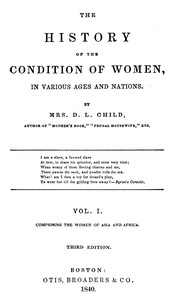
Read on Project GutenbergLydia Maria Child opens her survey of women in Asia and Africa with a striking contrast: the quiet pastoral life of ancient patriarchs, where 'physical strength, being the quality most needed, was most esteemed,' against the 'excitements which kindle the avarice and ambition of men in modern times.' This framing immediately establishes a moral and historical lens. The epigraph from Byron's Corsair—'I am a slave, a favored slave / At best'—sets a tone of indictment that runs through the volume, yet Child's voice is not uniformly polemical. In the China section, she shifts to a more ethnographic mode, detailing customs such as the formal 'taking leave of the old year' and the extreme filial piety that requires a son to divorce a wife displeasing to his parents. Her prose moves between moral commentary and descriptive reportage, a dual register that shapes the reader's experience.
Child begins with the Hebrew patriarchs, where women were 'naturally considered in the light of property' and a wife had to be purchased. This economic framing recurs throughout. Yet her tone is not uniformly condemnatory; she notes that in pastoral societies, the birth of a son was 'regarded as a far more fortunate event than the birth of a daughter,' a statement that blends observation with implicit critique. The transition to later empires—Assyria, Babylon, Persia—introduces a more critical voice. Child's language sharpens when describing the harem system or the exposure of infant girls in China, where 'as many as twenty or thirty thousand infants are annually exposed.' She does not simply report; she selects details that underscore the devaluation of women across cultures, creating a cumulative argument through juxtaposition.
The China section is the longest and most detailed in the excerpts. Child weaves together accounts of filial obligations—a son must present water to his parents at daybreak, and cannot wear white while they live—with a dramatic anecdote about Emperor Kien-Long. After his empress hangs herself over his infatuation with a young girl, one son appears in 'a full dress over a suit of mourning,' enraging the emperor so much that he kicks him to death. Child includes the empress's will, a 'curious document' in which she thanks her son for dancing and reciting poems. This blend of ethnographic detail and court intrigue reveals Child's narrative strategy: she uses vivid, often shocking examples to hold the reader's attention while advancing her argument about women's subordination. The pace quickens in such passages, then slows for descriptive set-pieces like the New Year festivities.
Child's narrative voice is not static. In the opening pages, she adopts a measured, almost scholarly tone, citing the 'simplicity' of patriarchal occupations. But as she moves through Asia and Africa, her language becomes more pointed. Describing the Bedouin Arabs or the Hottentots, she often inserts moral judgments: 'the most honorable distinction of women' in one culture becomes 'cruelly exposed' in another. The pace varies accordingly: dense, factual paragraphs on Chinese filial piety give way to brisk, anecdotal accounts of the empress's suicide or the emperor's kick. This rhythmic variation keeps the reader engaged, even as the catalog of customs risks monotony. Child's editorial hand is evident in her selection of sources—travel narratives, histories, and missionary accounts—which she weaves into a coherent, if partisan, narrative. The result is a work that is as much moral argument as historical survey.
Readers should attend to the way Child structures her evidence: she moves from region to region, but her thematic focus on property, motherhood, and legal status provides a unifying thread. The excerpts suggest that her method is comparative rather than chronological, and that she relies heavily on European travelers' accounts—a fact that invites scrutiny of her sources. The volume's title promises a history of women's condition, but Child's voice is that of a reformer as much as a historian. For those interested in the development of American feminist thought, this work offers an early example of how women's subordination was framed as a global, not merely local, phenomenon.
Reading Child’s account of Chinese women, I remembered my grandmother’s stories about her own grandmother—silent, deferred, yet quietly fierce. That ache of unspoken lives surfaced again in The Negro — Story, Setting & Ideas, where dignity persists under erasure. Both books feel like lanterns held over deep wells, illuminating not just conditions, but the weight of witnessing. I sat with that heaviness for a while, grateful for the company.
Use these questions to collect your thoughts before moving on.









