About 262 minutes
Kinship Organisations and Group Marriage in Australia — Reading Notes
Customs Everyday Life
60,059 recorded words. 5 minutes difference from this book's estimate.
View Gutenberg source #17404
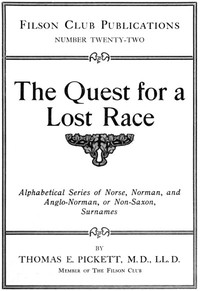
Before opening The Quest for a Lost Race — Background and Themes, the edition data offers a quick orientation: 61,284 words, 4 hr 27 min estimated reading time, and 32 detected text sections.
The text analysis averages about 16.1 words per sentence, while the detected sections provide another way to judge how the source is divided.
Project Gutenberg metadata also associates the work with “Names, Personal -- English,” connecting these edition facts with the source record’s subject description.
Explore this collection
These alternatives are selected using recorded categories and estimated reading time.
About 262 minutes
Customs Everyday Life
60,059 recorded words. 5 minutes difference from this book's estimate.
View Gutenberg source #17404About 357 minutes
Customs Everyday Life
81,970 recorded words. 90 minutes difference from this book's estimate.
View Gutenberg source #76362About 394 minutes
Customs Everyday Life
90,432 recorded words. 127 minutes difference from this book's estimate.
View Gutenberg source #61662Search stored excerpts and compare books → Choose by your preferences →
Choices use stored catalog measurements. Estimates vary with reading speed. A shared category is a catalog label, not a claim that two books have the same argument or literary quality.
Search reads excerpt text stored with this catalog and links to its associated Gutenberg record. The connection is stored in the site database; this tool does not recheck that every excerpt is word-for-word identical to that external record. Excerpt search does not cover every chapter and does not verify historical publication dates.
Catalog snapshot checked: 2026-09-25. Coverage: 91 public books, 91 available source excerpts.
Read the complete public-domain text at its original source.
Read on Project GutenbergThomas E. Pickett, a Kentucky physician and member of the Filson Club, opens his 1906 lecture with a striking blend of local patriotism and ethnological ambition. He declares the native Kentuckian's affection for the 'Old Commonwealth' as 'passionate' and 'irrational,' comparing it to a Frenchman's love of France. This preface immediately establishes a dual focus: the character of Kentuckians and the racial origins of English-speaking peoples. Pickett's central thesis, drawn from Paul B. Du Chaillu, is that the English race descends from Scandinavians (Normans and Danes) rather than Teutons (Germans). The work is structured around an 'Alphabetical Series of Norse, Norman, and Anglo-Norman, or Non-Saxon, Surnames,' with accompanying notes meant to demonstrate that Kentuckians have 'bred true' to this ancient blood.
Pickett devotes considerable attention to the Norman quality of 'craft,' drawing on the historian Freeman. He describes it as 'a special power of intellect'—'intellect fused with instinct and directed by a conscienceless common sense.' This trait, he argues, was evident in legal proceedings, court intrigues, ecclesiastical relations, and especially war. The Saxon, by contrast, 'fell short' in 'the wiles of war.' Pickett supports this with French proverbs: 'C'est un Normand, c'est un fin Normand' and 'Réponse normande, réponse ambiguë.' He notes that in the medieval struggle for existence, 'astuteness and duplicity were the winning cards,' citing the folk figure Renard as the popular favorite over the imperious Isangrim. This emphasis on craft as a hereditary trait underpins Pickett's argument that the Norman element became dominant in the English 'blend.'
Throughout the excerpts, Pickett repeatedly ties his ethnological claims to the character of Kentuckians. He asserts that the Kentuckian is 'no degenerate product' of the ancestral 'blend' of Norman, Saxon, and Dane. The purpose of the surname list and notes is to show that 'in every characteristic respect he has bred true to the ancient blood.' Pickett even suggests that the Kentuckian's supposed stubbornness and impatience with discipline—criticized by 'captious martinets'—may be vestiges of this heritage. He compares the Kentuckian's loyalty to his state to a 'signal from the hereditary Chieftain of the Clan,' and describes the return of Kentuckians to their state as a 'portentous ethnic phenomenon.' This local focus gives the work a specific, regional grounding that distinguishes it from a purely academic treatise.
The core of Pickett's argument rests on an 'Alphabetical Series of Norse, Norman, and Anglo-Norman, or Non-Saxon, Surnames.' He treats surnames as traces of racial origin, claiming that the English-speaking people of today are descended from Scandinavians rather than Teutons. The excerpts do not include the actual list, but the preface and notes frame it as a demonstration that Kentuckians carry 'the characteristic traits which are stamped upon the Kentuckian of to-day.' Pickett also invokes the concept of 'germ-plasm' and 'natural selection,' suggesting that Destiny directed the evolution of the English race. The work thus blends onomastics with a quasi-biological racial theory, though the excerpts provide only the theoretical framework, not the detailed evidence.
Readers approaching The Quest for a Lost Race should note that the excerpts present only the preface and a portion of the argumentative chapters. The full text includes an extensive alphabetical list of surnames with notes, which constitutes the primary evidence for Pickett's thesis. The work is best understood as a period piece reflecting early twentieth-century racial theories and regional pride, rather than as a modern ethnological study. Pay attention to how Pickett weaves together local Kentucky references with broader claims about Norman and Scandinavian heritage, and consider the rhetorical strategies he uses to persuade his Filson Club audience.
I keep thinking about that old Filson Club book, how Pickett traced Kentucky bloodlines back to Scandinavia with such quiet certainty. It stayed with me because he cared less about proof than about belonging somewhere ancient. Reading Sidelights on Chinese Life — Key Ideas to Explore felt similar—not a search for facts, but for the tender, ordinary threads that tie a people to their past.
Build a private reading journal entry for this title.