About 575 minutes
Sidelights on Chinese Life — Key Ideas to Explore
Customs Everyday Life
132,142 recorded words. 20 minutes difference from this book's estimate.
View Gutenberg source #39486
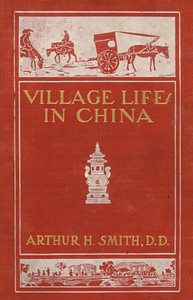
The source record for Village Life in China: A Study in Sociology — Reading Companion measures this digital text at 127,606 words, 9 hr 15 min estimated reading time, and 16 detected text sections.
The text analysis averages about 27.0 words per sentence, while the detected sections provide another way to judge how the source is divided.
Project Gutenberg metadata also associates the work with “China -- Social life and customs,” connecting these edition facts with the source record’s subject description.
Explore this collection
These alternatives are selected using recorded categories and estimated reading time.
About 575 minutes
Customs Everyday Life
132,142 recorded words. 20 minutes difference from this book's estimate.
View Gutenberg source #39486About 615 minutes
Customs Everyday Life
141,417 recorded words. 60 minutes difference from this book's estimate.
View Gutenberg source #42997About 452 minutes
Customs Everyday Life
103,913 recorded words. 103 minutes difference from this book's estimate.
View Gutenberg source #28432Search stored excerpts and compare books → Choose by your preferences →
Choices use stored catalog measurements. Estimates vary with reading speed. A shared category is a catalog label, not a claim that two books have the same argument or literary quality.
Search reads excerpt text stored with this catalog and links to its associated Gutenberg record. The connection is stored in the site database; this tool does not recheck that every excerpt is word-for-word identical to that external record. Excerpt search does not cover every chapter and does not verify historical publication dates.
Catalog snapshot checked: 2026-09-25. Coverage: 91 public books, 91 available source excerpts.
Read the complete public-domain text at its original source.
Read on Project GutenbergArthur H. Smith's Village Life in China opens with a description of a Chinese funeral that is anything but solemn: sixteen bearers wrestle with a ponderous coffin, a director shrieks in a falsetto key, and mourners wail amid the explosion of crackers. Smith, a missionary who spent twenty-six years in China, does not offer a detached overview but plunges the reader into the sensory chaos of village ritual. His prose is precise and unflinching, noting how a funeral director's cries resemble 'the scream of a catamount' and how bearers respond with shouts like 'sailors heaving an anchor.' This is not a generic account of Chinese customs; it is a study grounded in the specific, the physical, and the often discordant realities of rural life.
Smith's approach is that of a long-term resident, not a passing traveler. He notes that a foreigner who has lived in China 'long enough to take in its external phenomena, but not long enough to perceive the causes of them' would misunderstand what he sees. Smith himself aims to go deeper, and his writing reflects this. He describes a funeral dispute where two sets of bearers argued over precedence, leaving a coffin by the roadside for days—a detail that reveals his attention to the friction between ritual and human stubbornness. He also observes that farmers whose crops are trampled during funerals throw earth at the procession, a protest he calls 'wholly futile.' These moments show Smith as a witness who records both the intended order and the actual disorder of village life.
Smith dissects the layers of mourning practice with ethnographic care. He explains the 'Five Degrees of Relationship' (wu fu) that dictate who wears white, and notes that married daughters may receive cloth from their husband's family as a mark of honour. A woman carrying a 'huge bolt of wholly superfluous cloth' through a funeral is, in Smith's reading, performing a public testimonial that her husband's family has 'done the correct thing,' thereby giving her 'a large supply of face.' The term 'face' appears without explanation, suggesting Smith expects his reader to be familiar with the concept. His descriptions are dense with such social calculations: the size of the funeral retinue, the number of bearers (multiples of sixteen), and the noise of crackers and bombs all signify status and obligation.
Smith repeatedly foregrounds sound as a key element of village ceremonies. The funeral director's 'shrill shouts in a falsetto key ending in a piercing cry' are answered by the bearers' 'shouts resembling those of sailors heaving an anchor.' Mourners add 'ostentatious wails,' and the whole is punctuated by 'the explosion of more crackers and bombs.' The effect, Smith writes, is 'as remote from our conception of what a funeral ought to be as can easily be imagined.' He does not judge this distance as inferior; he simply registers it. His ear for the cacophony—the 'tumultuous and discordant' responses, the 'buzz of the curious spectators'—turns the funeral into a sonic event, one where no one pays attention to anyone else, and the dead are 'laid away to his long rest' amid chaos.
The provided excerpts cover only two chapters—one on funerals and the opening of a chapter on New Year—plus the foreword and front matter. From these, we can see Smith's interest in the mechanics of ritual, the role of 'face,' and the friction between ideal practice and real behaviour. But we cannot infer the book's overall argument or its treatment of other topics like economics, kinship, or religion. The foreword states that Smith writes from 'profound respect' for the Chinese, yet the funeral chapter dwells on conflict and futility. Whether this tension persists throughout the work is unclear. Readers should approach the full text as a series of discrete observations rather than a unified thesis, and be alert to the author's position as an outsider with a specific cultural lens.
Smith's study rewards readers who attend to the concrete: the weight of a coffin, the pitch of a shout, the cloth a woman carries. His prose is at its best when it lets these details speak, rather than when it generalises. To read Village Life in China is to follow a careful observer through the noise and mud of village events, and to see how much of social life is performed, contested, and patched together. The book is not a systematic sociology but a collection of scenes, each dense with implication.
Rereading Arthur Smith’s notes on funeral rites, I was struck by how much hinges on unspoken communal duty. That weight of expectation, of performance carrying generations, lingered with me afterward. It quietly drifted toward another old fascination of mine, The Quest for a Lost Race — Background and Themes, where belonging feels just as heavy. Both left me simply sitting with the strange, persistent pull of collective memory.
Build a private reading journal entry for this title.