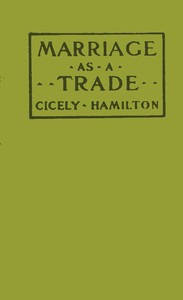
Cicely Hamilton opens Marriage as a Trade with a pointed declaration: the book addresses the "trade aspect of marriage"—wifehood and motherhood considered as a means of livelihood for women. From the first paragraph, she establishes a structural parallel between marriage and other industries, insisting that an inquiry into the conditions under which the wife and mother plies her trade is as justifiable as an inquiry into mining or cotton-spinning. This framing sets up a recurring movement in the text: Hamilton repeatedly shifts between the domestic sphere and the language of labor, economics, and production.
The Trade as a Moulder of Character
Hamilton argues that the manner in which a human being earns a livelihood tends to mould and influence character—to warp or improve it. She applies this principle directly to women: "the trade of marriage tends to produce its own particular type." The woman we know, she contends, is largely the product of the conditions imposed by her staple industry. This observation is traceable to the preface, where she writes that particular trades develop particular types, and that the boy who becomes a soldier will not turn out the same as one who enters a stockbroker's office. By extending this logic to marriage, Hamilton transforms a personal relationship into an economic category, and she does so without sentimentality. The structure of her argument relies on this analogy: if mining can brutalize a miner, then the conditions of wifehood can warp a woman. The evidence for this claim is not drawn from individual case studies but from a broad historical and economic perspective, which she sustains throughout the text.
The Medieval Alternative: Conventual Life as Economic Escape
Hamilton introduces a historical counterpoint to the marriage trade: the medieval institution of chivalry and the conventual life. She notes that chivalry flourished when women had an alternative career in the religious life, "equally honoured with, if not more honoured than, marriage." The convent, she argues, stood for the principle that woman had an existence of her own apart from man—a soul to be saved apart from man. This is a structural move: by contrasting the marriage market with a system that allowed celibacy to be honourable, she highlights the economic congestion caused by compulsory marriage. The convent, she writes, "must have lessened the congestion in the marriage market by lessening the number of women who regarded spinsterhood as the last word in failure." This observation is grounded in the text's own phrasing, and it reveals Hamilton's method of using historical institutions to critique present conditions. She acknowledges that the convent had drawbacks, but insists that its unforeseen economic results were real.
Respect, Reverence, and the Animal Function
A recurring image in Hamilton's argument is the comparison of women to rabbits. She writes: "if woman is reverenced only because she reproduces her kind, a still higher meed of reverence is due to the rabbit." This blunt analogy recurs in her discussion of respect: she claims that a woman who insists on standing on her own feet will get respect, even if grudgingly, while a woman who performs only animal functions cannot command reverence. The image of the rabbit serves as a rhetorical device to deflate sentimental views of motherhood. Hamilton extends this to argue that it is impossible for any thinking man to entertain real reverence for a section of humanity he believes to exist solely for reproduction. The structure of this section moves from the general principle that trades produce types to a specific critique of the valuation of women. The evidence is in the text's own language: the rabbit comparison appears twice in the excerpts, and it is tied to a broader argument about the need for women to have other claims to respect.
The Unforeseen Results of Economic Structures
Hamilton is attentive to unintended consequences. In discussing the convent, she notes that its effects—freeing women from compulsory marriage—were "unforeseen results, but none the less real because unforeseen." This attention to structural outcomes rather than intentions is a hallmark of her method. She does not attack the institution of marriage itself, but the conditions attaching to it as it exists today. Her goal is to point out "certain grave disadvantages" that are largely unnecessary and avoidable. The movement of her argument is from the specific trade conditions to their effects on women's mental, physical, and moral development. She does not claim to have a complete solution, but she insists that alteration is needed. The evidence for this is in her preface, where she states that she desires improvement not only for women's own interests but for the race in general. This section ties together the economic and the moral, showing how Hamilton's structure consistently returns to the idea that material conditions shape human character.
Hamilton's argument is built on a series of structural analogies—marriage as trade, woman as product, the convent as economic alternative. Readers will find that the text moves between historical example and contemporary critique, always returning to the economic conditions that shape women's lives. The excerpts suggest a work that is more analytical than anecdotal, more concerned with systems than with individuals. For those interested in the intersection of feminism and economic thought, this book offers a clear, if polemical, framework.
Reading Marriage as a Trade, I kept thinking about how surprisingly fragile our domestic certainties are—how a home can be both shelter and transaction. That quiet unease reminded me of an old shipwreck account, Ye antient wrecke—1626 — Edition Insights, where the same sea that carried goods also carried loss, and the ledger of survival was written in small, stubborn choices.