About 286 minutes
The mind of primitive man — Text and Context
Society Culture
65,738 recorded words. 21 minutes difference from this book's estimate.
View Gutenberg source #71630
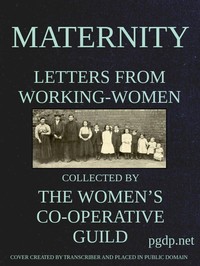
The catalog record for Maternity: Letters from Working-Women — Edition Insights provides practical reading context through 70,452 words, 5 hr 7 min estimated reading time, and 18 detected text sections.
The text analysis averages about 19.9 words per sentence, while the detected sections provide another way to judge how the source is divided.
Project Gutenberg metadata also associates the work with “Mothers -- Great Britain -- Biography,” connecting these edition facts with the source record’s subject description.
Explore this collection
These alternatives are selected using recorded categories and estimated reading time.
About 286 minutes
Society Culture
65,738 recorded words. 21 minutes difference from this book's estimate.
View Gutenberg source #71630About 270 minutes
Society Culture
62,027 recorded words. 37 minutes difference from this book's estimate.
View Gutenberg source #50639About 350 minutes
Society Culture
80,358 recorded words. 43 minutes difference from this book's estimate.
View Gutenberg source #62342Search stored excerpts and compare books → Choose by your preferences →
Choices use stored catalog measurements. Estimates vary with reading speed. A shared category is a catalog label, not a claim that two books have the same argument or literary quality.
Search reads excerpt text stored with this catalog and links to its associated Gutenberg record. The connection is stored in the site database; this tool does not recheck that every excerpt is word-for-word identical to that external record. Excerpt search does not cover every chapter and does not verify historical publication dates.
Catalog snapshot checked: 2026-09-25. Coverage: 91 public books, 91 available source excerpts.
Read the complete public-domain text at its original source.
Read on Project GutenbergThe letters in this collection were written by working women—mill workers, weavers, wives of men earning between ten shillings and three pounds a week—and they speak in a voice that is neither polished nor detached. The Women's Co-operative Guild, which solicited these accounts, did not ask for literary essays; they asked for experience. What emerges is a record of bodies under pressure: pregnancies managed alongside twelve-hour shifts, babies born prematurely after heavy lifting, and confinements attended by ignorance as much as by poverty. The preface by Herbert Samuel notes that this is the first time such facts have been stated "not by medical men or social students, but by the sufferers themselves." That distinction matters. The prose is unadorned, often grammatically rough, and precisely because of that, it carries a documentary weight that no reformer's summary could match.
The correspondents describe their physical experiences with a directness that is startling even a century later. One woman recounts a first confinement complicated by convulsions, which the doctors attributed to "the clogged condition of the bowels." She had been "too shy and reticent to ever mention my condition to neighbours" and had never taken medicine, assuming constipation was a normal result of pregnancy. Another writes of varicose veins so severe that she could not "get about so well," yet she still managed ordinary housework. The language is functional—these women are not performing suffering for an audience. They report symptoms as facts: lifting pieces off looms, walking half an hour before dawn, standing all day. The body is the primary source of evidence, and the letters accumulate details that medical textbooks of the era would have omitted.
Economic pressure dictates the rhythm of maternity in these letters. A weaver explains that her first baby arrived early because she had to lift heavy pieces from the loom onto her shoulder and carry them across the yard. Her husband was "short of work," so she could not stay home. With her second child, he worked only three months out of the nine; she returned to the mill at the month-end, putting the baby out to nurse. The schedule is precise: up at four, walk half an hour to her mother's with the baby, stand at work until half-past five, then walk back. She did this with three children. Another correspondent, earning 17s. 6d. to £2, argues that if mothers received the same money as old-age pensioners, they would "have less to waste." The letters repeatedly tie physical hardship to the inflexibility of wage labor.
A recurring theme is the isolation enforced by propriety. The woman who suffered convulsions had lived "eighty miles away from home" and was "away from my mother at the time." She had been living with a "strictly particular widow lady" and had "hardly ever heard such things discussed." That silence nearly killed her. Another correspondent, who had eight children and never lost one, insists she "never can say I have not had every care on every occasion." Her husband provided the necessary requirements. The contrast between these two accounts—one marked by fatal ignorance, the other by consistent support—suggests that the quality of maternity depended less on income than on access to information and a partner's cooperation. The letters do not moralize; they simply present the conditions under which knowledge was withheld or shared.
Several letters mention the use of instruments during childbirth. The weaver who worked through three pregnancies states flatly: "all my children have had to be brought with instruments." She does not elaborate on the procedure, nor does she express outrage. The detail is offered as a matter of course, a routine intervention that accompanied her particular history of hard labor and premature births. Another woman, after describing a twenty-four-hour labor and convulsions, notes that "another doctor was fetched, and the child was got away somehow." The vagueness of "somehow" is telling—it marks the limit of her knowledge and the point at which medical authority took over. These references to forceps or other interventions are never sensationalized. They appear as one more fact in a litany of facts, which is what makes them so affecting.
Readers should approach these letters as testimony rather than narrative. There is no arc, no resolution, and the writers do not reflect on the meaning of their experiences. The value of the collection lies in its accumulation of concrete, unglossed detail—the wages, the hours, the distances walked, the number of children buried or alive. Because the Guild preserved the letters with minimal editing, the reader encounters the women's own syntax and emphasis. That directness is the book's primary argument.
These letters remind me of my grandmother’s quiet hands, always mending something. Reading them, I felt that same ache of unspoken sacrifice I once found in Culture & Ethnology — Background and Themes, where daily customs hold deeper weight. Both books whisper about lives shaped by forces we seldom name, just softly, like rain on a window. That old feeling returned—of being let into a private, centuries-long conversation.
Create a short personal record of your experience with this book.