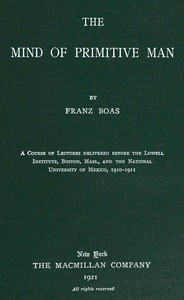
Franz Boas opens The Mind of Primitive Man not with a definition of primitive mentality but with a blunt examination of racial prejudice. The first chapter, “Racial Prejudices,” immediately questions whether the white race’s higher civilization proves a superior physical or mental type. Boas insists that cultural achievement depends on historical accident and diffusion, not hereditary aptitude alone. He points to early American civilizations and the many races that contributed to human progress, then turns to anatomy—brain size, structure, and bodily traits—to show that no reliable correlation exists between physical markers and mental ability. The argument is built on evidence, not assertion, and sets the stage for a systematic dismantling of racial hierarchy.
Language as a Mirror of Need, Not Capacity
Boas devotes considerable attention to language, using it as a key example of how environment shapes thought. He observes that in many so-called primitive languages, generalized forms of expression are rare, but this does not indicate an inability to form abstractions. Instead, the mode of life simply does not require them. He illustrates with the example of a western language where the idea “to be seated” is almost always expressed with an inseparable suffix indicating the place—on the floor, on the ground, on the beach. Only when the state of sitting itself is emphasized does a generalized form appear. Boas argues that such devices exist but are seldom needed, and would develop as soon as required.
He extends this reasoning to numeral systems. Many languages have only two or three numerals, yet the people—such as South American Indians or Eskimo—adopt higher numerals with ease when contact with civilization makes counting necessary. Boas notes that counting only becomes necessary when objects are considered in a generalized form, losing their individualities. A person may own a herd of domesticated animals and know each by name without ever counting them. The lack of numerals, he concludes, is no proof of inability to form the concept of higher numbers.
The Moulding of Language by Culture
Boas turns the relationship between language and thought on its head. He argues that European languages have been moulded by the abstract thought of philosophers, with terms like “essence” and “existence” being artificial devices for expressing abstract results. These resemble the unidiomatic abstract terms that can be formed in primitive languages. Thus, the obstacles to generalized thought inherent in language form are of minor importance. Language alone would not prevent a people from advancing to more generalized thinking if their culture required it. Instead, language is moulded by the cultural state. Boas finds no direct relation between a tribe’s culture and its language except insofar as the form of language is shaped by the state of culture. This argument directly challenges the notion that language determines thought or that primitive languages reflect primitive minds.
Structure and Movement: From Prejudice to Evidence
The book’s structure mirrors its argumentative method. Boas moves from the broadest question—racial prejudice—to specific domains: anatomy, environment, language, and culture. Each chapter builds on the last, but the movement is not linear; he repeatedly returns to the theme that observed differences are products of history and circumstance, not innate endowment. The excerpts show a careful progression: after dismantling anatomical arguments, he turns to environmental influences, then to language and thought. The recurring image is that of a tool or device—language, numerals, concepts—that exists but is used only when needed. Boas emphasizes that the tribe as a whole adjusts to new needs, suggesting a collective adaptability rather than individual limitation. This structural choice reinforces his central claim: that the mind of primitive man is not a different kind of mind, but one shaped by different conditions.
The Role of the Observer: Boas’s Own Position
Throughout the excerpts, Boas positions himself as an empirical scientist, not a polemicist. He draws on his own fieldwork—the Handbook of American Indian Languages and reports on immigrant bodily form—to ground his claims. He acknowledges that his views have developed over many years, citing earlier essays from 1894 to 1910. This self-awareness is part of the book’s structure: Boas is not presenting a finished system but a cumulative argument. He warns against the comparative method that leaps to conclusions from isolated traits, and instead advocates for historical and contextual analysis. The reader is invited to follow the evidence, not the prejudice. Boas’s tone is measured, but his conclusions are radical for 1911: that racial hierarchy is a cultural artifact, not a biological fact.
Boas’s lectures, delivered at the Lowell Institute and the National University of Mexico in 1910-1911, remain a landmark in anthropology. Readers should attend to how he uses specific linguistic and cultural examples to undermine broad generalizations. The book rewards careful attention to its structure: each chapter reframes the problem, moving from anatomy to environment to language, always returning to the idea that human minds are shaped by need and history. Boas does not claim to have the final word, but he provides a rigorous framework for questioning assumptions about race and intelligence.
Reading The Mind of Primitive Man, I kept thinking about how Boas gently dismantled assumptions by grounding everything in lived circumstance. It reminded me of a different kind of patient observation, a quiet chronicle of people whose ways were misread simply because no one bothered to listen. That same tenderness for lived detail lives in Romany Life Experienced and Observed during many Years of Friendly Intercourse with the Gypsies — Background and Themes, where understanding grows from simply spending time.