About 83 minutes
The Negro and the nation — Key Ideas to Explore
Society Culture
18,996 recorded words. 10 minutes difference from this book's estimate.
View Gutenberg source #69835
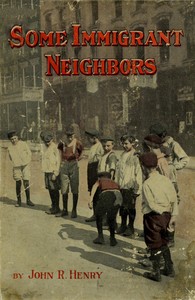
Some Immigrant Neighbors — Background and Themes can be approached with a clearer sense of reading commitment from its source measurements: 21,205 words, 1 hr 33 min estimated reading time, and 13 detected text sections.
The text analysis averages about 20.0 words per sentence, while the detected sections provide another way to judge how the source is divided.
Project Gutenberg metadata also associates the work with “Noncitizens -- United States,” connecting these edition facts with the source record’s subject description.
Explore this collection
These alternatives are selected using recorded categories and estimated reading time.
About 83 minutes
Society Culture
18,996 recorded words. 10 minutes difference from this book's estimate.
View Gutenberg source #69835About 68 minutes
Society Culture
15,593 recorded words. 25 minutes difference from this book's estimate.
View Gutenberg source #70759About 55 minutes
Society Culture
12,618 recorded words. 38 minutes difference from this book's estimate.
View Gutenberg source #63231Search stored excerpts and compare books → Choose by your preferences →
Choices use stored catalog measurements. Estimates vary with reading speed. A shared category is a catalog label, not a claim that two books have the same argument or literary quality.
Search reads excerpt text stored with this catalog and links to its associated Gutenberg record. The connection is stored in the site database; this tool does not recheck that every excerpt is word-for-word identical to that external record. Excerpt search does not cover every chapter and does not verify historical publication dates.
Catalog snapshot checked: 2026-09-25. Coverage: 91 public books, 91 available source excerpts.
Read the complete public-domain text at its original source.
Read on Project GutenbergJohn R. Henry, a New York City pastor, wrote Some Immigrant Neighbors in 1912 as a junior home mission study text. The book opens with a blunt recitation of ethnic slurs—"Dago," "Sheeney," "Chink"—and immediately pivots to a theological claim: God does not shrink from any of these groups. Henry draws on his own institutional and church work, not secondhand reports. The chapters are organized by nationality, each offering a mix of anecdote, labor observation, and moral appeal. The tone is earnest and reform-minded, aimed at young readers.
Henry includes a striking account of Italian laborers paving a city street under an Irish boss. The men were split into two gangs, racing to asphalt their half of a block for a keg of beer. Henry calls it "a cruel proof of what greed and a total disregard of the welfare of the poor immigrants could furnish." He does not name the street or the date, but the detail is precise: an August day, dead horses in the thoroughfares, and workers driven "at such inhuman speed." The passage is one of the few sustained narrative scenes in the excerpts.
Elsewhere, Henry cites a magazine investigation into the Erie Railroad's rock entrance near Jersey City. The railroad's press agent claimed no lives were lost; the investigation found twenty-five killed and many injured. The reply to the inquiry: "the killed were only Wops (Huns) and Dagoes." Henry uses this to illustrate how immigrant lives were discounted.
Henry devotes a chapter to Chinese immigrants, whom he calls "the most misunderstood people in America." He recalls an old geography book claiming that writing one's name in Chinese characters wins favor. Henry now doubts that generalization, noting that the Chinese are so diverse that "no author ... feels that he can give an account ... that he is sure will hold good in another" province or village. He offers a small, vivid detail: a Chinese person wanting to peep inside a house "applies a wet finger to a paper window" to create a tiny hole.
The chapter also notes migration numbers: in 1911, only 5,657 Chinese entered the U.S., while 7,065 returned to China. Henry does not explain the return flow, but the statistic suggests a pattern of sojourning rather than permanent settlement.
The book's foreword states its purpose: "an invitation to become acquainted with the immigrant and be his friend and good neighbor." Henry writes from the point of view of a pastor at the Church of All Nations in New York City. The chapter titles—"Our Jewish Neighbor," "Our Russian Neighbor," etc.—frame each group as a neighbor rather than a problem. Yet the book also includes a chapter called "Good Neighbors and Bad," suggesting a moral binary.
Henry acknowledges his sources: other writers, his staff, and the Rev. F. Mason North, who read the manuscript. The book is part of a series issued by the Council of Women for Home Missions. The combination of institutional backing and personal observation gives the text a hybrid character—part report, part sermon, part civics lesson.
Readers should note that Henry's book is a period document, not a sociological survey. His observations are filtered through a missionary lens and a desire to counteract prejudice. The excerpts show a writer who is willing to name slurs and describe exploitation, but who also reproduces stereotypes (e.g., "the Italian is naturally religious"). The value of the text lies in its specific, local details—the asphalt gang, the railroad deaths, the wet-finger peephole—rather than in its general claims.
In that 1912 mission study, I often lingered on the pastor's quiet notes about immigrant mothers—their strength worn patiently, like stone steps. It reminds me of another shelf, where Maternity: Letters from Working-Women — Edition Insights waits, its own voices speaking of the same unheralded grace. Both books, to me, share a knowing hush—a respect for dignity that never needed translating.
Use these questions to collect your thoughts before moving on.